

Communication in Relationships: You’re Not Arguing About the Dishes
Let’s just say it straight. Most couples are not struggling because they do not love each other. They are struggling because they have not yet learned how to talk to each other without things falling apart. That argument about the dishes is never really about the dishes, It’s about feeling unheard, unappreciated, or like you are carrying more than your share. Until you address how you communicate, you will keep having the same argument wearing different clothes.
Here is what most people get wrong. Communication is not simply saying what is on your mind. It is what you say, how you say it, when you say it, and what your face, tone, and body are doing while you say it. You can choose the right words and still wound your partner if your delivery is off. That is why you have probably said “that is not what I meant” while your partner sits there thinking “maybe not, but that is how it felt.”
The most common breakdown I see in couples work is not a lack of words. It is a lack of real listening. Most people are not listening to understand their partner, they are waiting for their turn to speak, quietly building a rebuttal, preparing their defense, or rehearsing their “but.” Meanwhile, their partner is wondering why they even started talking. When someone does not feel genuinely heard, the conversation is already over, even if both people are still in the room.
The research is clear on what kills communication in relationships. Criticism that attacks character rather than behavior, defensiveness that sidesteps accountability, contempt expressed through tone or dismissiveness, stonewalling that reads as abandonment, and the quiet devastation of assumption, arguing with a story in your head instead of the actual person in front of you. These patterns, identified by Dr. John Gottman as predictors of relational breakdown, show up in nearly every couple I have worked with. Recognizing them is the first step. Changing them is the work.
So what actually helps? Start by speaking from your own experience rather than cataloguing what your partner did wrong. “I felt hurt when you did not check in” opens a door. “You never care about me” closes it. The first invites connection. The second invites a fight. Your delivery matters just as much as your content, and choosing to speak from a place of feeling rather than accusation changes the entire temperature of a conversation.
One of the most underused tools in couples communication is the simple act of asking before assuming. Not every conversation is looking for a solution. Sometimes your partner needs to be heard, not fixed. Try asking “do you want me to listen or help problem-solve?” That one question eliminates a significant number of unnecessary arguments. And before you respond to what your partner has shared, reflect it back. “What I hear you saying is…” gives your partner confirmation that they were actually received, and it slows the conversation down enough for both of you to stay regulated.
Timing matters more than most couples realize. Bringing a sensitive topic into a moment when one or both of you is exhausted, already escalated, or under stress is not a conversation. It is a collision. Protect your important conversations by choosing moments when both of you have the capacity to actually be present for them.
This is the foundation of The Phillips Umbrella Framework. Communication is the umbrella that covers everything in your relationship. But the umbrella only holds if its spokes are intact. Respect, honesty, trust, vulnerability, accountability, emotional safety, active listening, and forgiveness are not separate topics. They are all part of the same structure. Weaken one and the whole canopy feels the impact.
The truth most people do not want to sit with is this. You cannot build trust without respect. You cannot access vulnerability without emotional safety. You cannot repair communication by simply talking more. Communication is a system, and if one part of that system is compromised, everything else feels off no matter how hard you try.
Here is what I want you to carry into your next conversation. Ask yourself whether you are speaking from love or from hurt. Ask whether you are genuinely trying to understand your partner or simply trying to be right. Ask whether the way you are about to say something will bring the two of you closer or push you further apart. Because the goal was never to win the argument. The goal is to stay connected inside of it. It has never been you versus your partner. It is both of you, together, versus the problem.
That shift in perspective changes everything.
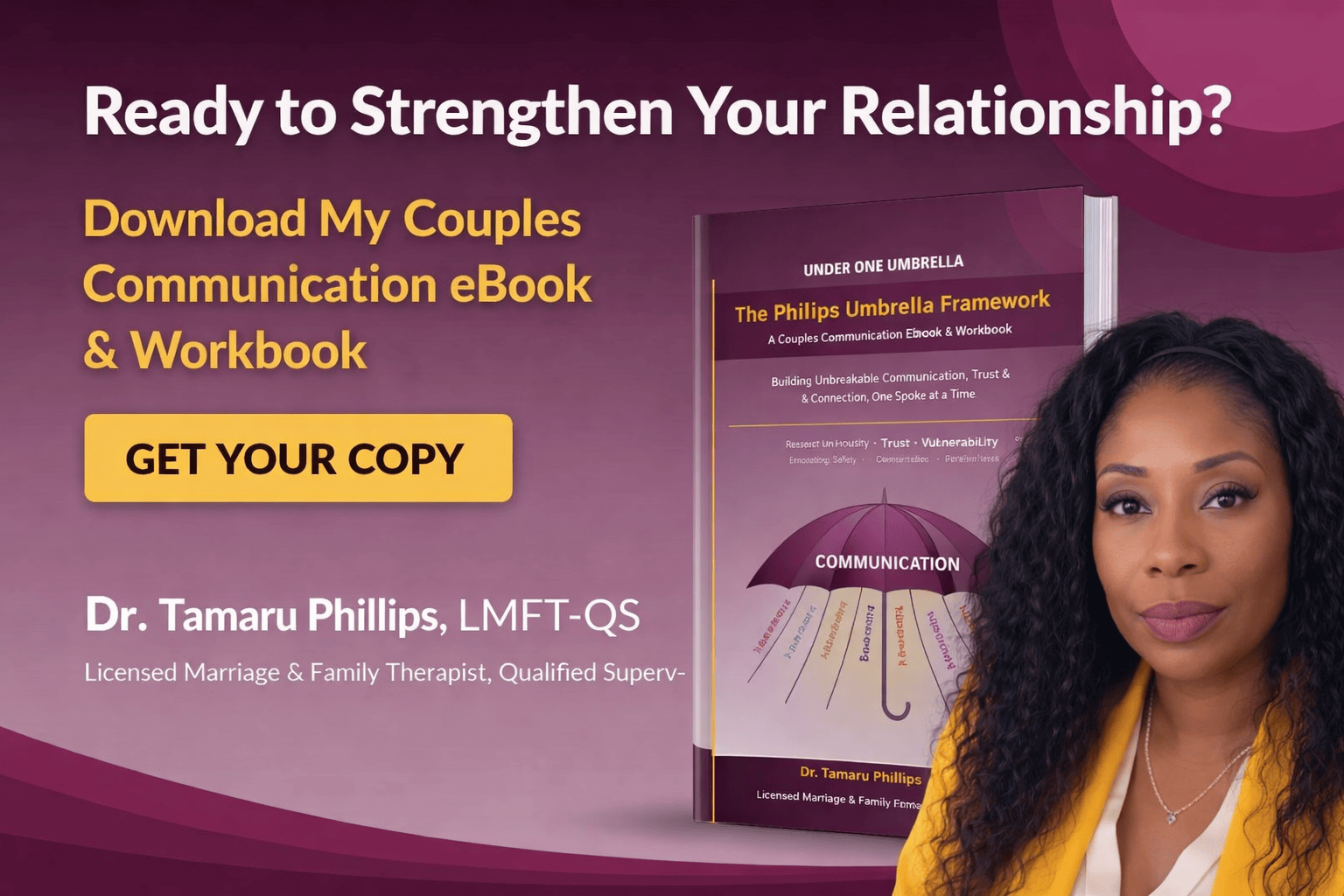
If this resonates with you and you are ready to go deeper, my couples communication workbook, Under One Umbrella: The Phillips Umbrella Framework, walks you and your partner through each of these principles with clinical depth, original exercises, and real strategies you can begin using today. The link is below.
Until next time, take care of each other.
If this resonated with you, I want you to have more.
Under One Umbrella: The Phillips Umbrella Framework is my original clinical couples communication workbook, built for couples who love each other but keep getting lost in translation. It walks you through all eight spokes of the framework, respect, honesty, trust, vulnerability, accountability, emotional safety, active listening, and forgiveness, with clinical depth, original couples exercises, writing space for both partners, and a progress tracker.
Evidence-based. Warm. Practical. Written by a licensed therapist who has sat with real couples doing real work.
You do not have to be in crisis to benefit. You just have to be willing to show up.
👉 [Grab your copy below, instant PDF download, available now !
https://balancedmindproject.com/product/phillips-umbrella-framework/ .]
Your relationship is worth it.
Discover more from Balanced Mind Project
Subscribe to get the latest posts sent to your email.
